My Calendar
January 2012
M T W T F S S
« Nov    
 1
2345678
9101112131415
16171819202122
23242526272829
3031  
Sponsered Links

Life Saving Techniques for your pigeon:Step 1 of 3 HEAT!

We don’t like to dwell on it but an unfortanate part of life is that your pigeon may need emergency care.  I am including a three step basic process to help you in the event you face a dire issue for your pigeon.  As allways consult with an experienced rehabber or avian vet if situation gets worse or unsure of any procedure.


HEAT

As with pigeons and any bird they must be warmed gradually to a normal body temperature.  Be careful on ensuring a gradual warming to reach a temperature for your pigeon to be responsive and able to swallow.

It should come to no suprise or unusual for a baby pigeon presented for rehabilitation to be very cold.  If a bird is unresponsive it is allways best and recomended to seek the assitance of an experienced rehabber or avian vet immediately.  Give your pigeon a quick, superficial examination.

Unless there is a critical situation such as severe bleeding your pigeon should be covered and placed on a heat source for at least 20-30 minutes to bring the body temperature back to normal.

If you suspect head trauma do not place your pigeon on any heat or heat source.

* Heat source suggestions: Again these are suggestions!

1) The first suggestion is a towel lined heating pad, that is  set on low
2) The second suggestion is a towel lined hot water bottle.

3)  The third suggestion is a low wattage lamp that directly shines light into your loft or other housing for your pigeon.


* In the case of an Emergency here is a heat source substitute:

A) Fill and old sock with about 2/3 full of rice.  Next you will microwave the sock for a few seconds.  Be sure the sock
isn’t too hot, and then place it around the bird.

By following this basic step you will be ensure to provide basic care for your pigeon until further assitance could be given.

Racing Pigeon Loft: One Key Element You Must Have: BY ANDRE BANKS

Just imagine after building the pigeon loft of champions you find out that  you overlooked a vital element to your pigeons racing success. To make matters  worse you found out because of this missing element you have lost several key  races and if nothing is done your pigeons will continue to lose.

You may be  thinking to yourself this is an extreme what could be that important.

Let me  tell you my friend in racing pigeon’s one key element off of your loft can be  the means to winning or loosing.

Okay I think I given you enough reason to at least keep reading to find out  what the key element is. The element I am referring to here is the pigeon perch.  Now believe me, I didn’t realize the importance of this element either but  believe me it is pivotal for your loft since the comfort of your pigeons depends  on it.

Now the exact type of your pigeon perch will be different due to your breed  of pigeon. In most cases racing pigeons and fancy pigeons that look like racers  will and should have the same kind of perch.

The most common measurements for  these perches are approximately 10 inches square, with a depth ranging about 5  inches. These kinds of perches are commonly known as “box perches”. In more  cases than not these perches can be built in units and will fit smoothly into  the wall space at the back of your loft section.

Now take note these box pigeon perches are not really made for fancy pigeons  with more fluffy feathered legs. The reason being their feathers would easily  become dirty from the droppings. For this factor you should make a pigeon perch  that will allow your more feathered fancy to stand comfortably, without risking  his plumage getting damaged or dirty.

Now since the box perch will not be suitable in this case it is highly  recommend that you should think of designing the inverted “v” perch. These are  the best for the fancy breeds.Depending on your preference and what seems like  the norm of most fanciers many perches are designed as floor units. There are  pro’s and cons to this design but ultimately the decision is yours.

Now please pay attention because this is  important:  Perches are one of the key elements you must have  for your racing pigeon  loft but it is not the exclusive element. There are others that with  the constraints of an article I could not disclose. Now I will be remiss if I  did not give you this http://tinyurl.com/338vgxx/ as you clink on the link you  will see all you need for your racing pigeon loft.

Article Source: http://EzineArticles.com/?expert=Andre_Banks

PIGEON LOFT:3 Steps You Can’t Forget in Building One! by Andre Banks

Let me ask you this question. Did you know that there are 3 steps in building  your pigeon loft that you cannot forget? You’ll be surprise to discover that  many newcomers forget these three steps and their building ideas never really  take shape. This does not have to be the case since the steps are so simple in  nature and are many times overlooked. So what are the steps?


Step 1: Decide first hand how much money you are willing to spend and  stay to budget.

In beginning any building project it is crucial to keep costs to budget  projections. Building a pigeon loft is no different then any other construction  project. It needs to be taken seriously. Without a plan on how much money you  are able to devote to your pigeon loft and sticking to that amount you will  never get your hobby off the ground. The costs should be divided into three  areas: Materials for construction, secondary items for pigeon needs and growth,  and insulation costs. These costs may vary on your size and construction of your  loft so be mindful that larger may not always be feasible at first.

Step 2: Start small and know the building code of your state.

To many times newcomers get large ideas but don’t take into consideration  that starting small is ideal. Since the building of your loft has to be up to  code measurements for your state its best to begin small. In the case of your  loft not meeting state requirements it’s easier to correct code errors in  smaller lofts. As a rule of thumb 6m is a good starting size and should be  aligned with most state codes. It also goes without saying checking with your  neighbors and discussing your building plans would be ideal. You would hate to  have your building plans shut down when a simple conversation could suffice.

Step 3: Building of your loft should be done in sections.

No matter how much money you have in your budget to spend your loft should be  built in sections. If you are starting small as I suggested in step 2 your first  loft may just be one room with next boxes, some perches, food trays and water  hopper. This would be defined as your main section. The next section can consist  of putting in a partition wall in. Again this is just basics but it expresses  perfectly the idea of sections. Section building allows you the ease of  developing bigger in the future if you choose to. It also provides an added  bonus of being easier to maintain.

Now please pay close attention:

What I described in this article is just the beginning of three steps you  need and should not forget in building  your pigeon loft. However there is so much more to ensure your loft is built  correctly that’s why I am including a website that is devoted to this task check  out http//:www.pigeonloftdesign.com and get your building done  right.

Article Source: http://EzineArticles.com/?expert=Andre_Banks


Building Options for your loft: A way to cut costs!

There is a simple way to cut cost and that is to leave the insulation out on two of the walls and to not not finish that part of the inside that you did not insulate. I know it sounds a little bizzare but it does save money.


However their is a word of CAUTION : YOU MUST KEEP THE CEILING AND THE WEST WALL INSULATED. This is the only way  to protect your pigeon’s and consequently your loft from getting too warm from the hot sun especially during the summer.

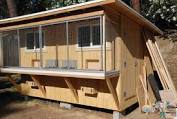
Another option you can try is  a one way slanted roof with one wall at six feet and the opposite one at seven feet.  Now many people may not like this look because it can remind you of an old chicken coop.  But it is an option and you may not mind that look.  The draw back besides looking possibly like a chicken coop is that your door will have to go on the seven foot side.  However you can get around this by building your own door.

You will find out there is no two pigeon lofts alike even when people follow the same blue print.  While each pigeon loft serves the same basic purpose which is to provide a warm dry safe haven for your pigeon and their offsprings you can be creative and show off your unique style and design.

Hey here is my shameless plug this guy is an expert at Pigeons and if you do not purchase his book you are being left out in the cold.  All you need to know on how to race breed and make money with your pigeons can be found right here don’t hesitate and not purchase this book

Converting any outdoor structure to a perfect pigeon loft by Elliot Lang

Now there are some great ideas people have for lofts and then their are individuals who are in a class all of their own.  Here is a great article from Elliot Lang.  I am also including his book if you want to bring your loft and breed pigeons to the next level he is one you need to follow.


Here is his article.

Over the years, every possible location for a pigeon loft has been used. In  Belgium and Holland, some of the best fanciers are still regularly installing  lofts and keeping pigeons literally in their lofts!

Although this is both convenient and easily accessible from within the house,  it really isn’t as sanitary as an outdoor space for your birds. In a lot of  places it is actually illegal to keep pigeons inside your house and will result  in your local sanitary inspector or public health officer shutting you down.

With very little cost you can convert almost any outdoor structure into a  great loft that your pigeons will be happy in. It could be a shed, a grainary or  an old barn; anything has potential!


As an example of this, during World War II, the British Army converted a  number of double decker buses into huge, portable pigeon lofts that could easy  store hundreds of birds. The only real limit is your imagination (so long as  it’s in a healthy environment: you don’t want the pigeon loft to make your  pigeons ill),

There are pigeon fanciers who only build their lofts above stables with the  belief that the strong smell of the manure will help their pigeons find their  way home. It could be true, but you can never be certain! All I can think about,  in this situation, is that pigeon lofts above stables will have all sorts of  horrible vapours seeping up into the air that your pigeons are breathing, which  may cause them a great deal of discomfort.

In reality, for most people, the best and cheapest structures for converting  will be old sheds, potting sheds or garages.


BUILDING OPTIONS: PIGEON LOFT IDEAS FOR THOUGHT!

Here is several building options that serve as food for thought.  Each one of us has different needs and what I suggest here is a way to bring out your ideas into putting your dream pigeon loft to motion.

After all its all about you and what you think is right for your pigeons.


OPTION #1
If you feel that you need a larger loft here is a suggestion intstead of building from scratch just expand the dimensions of your loft to add on a compartment.  This seems self explanatory. But if you are just starting out I wrote an article that explained the importance of drawing your blue print of what you have in mind for your pigeon loft first.  This is the most smart and financially sound way to function since the blueprint is in place you can just expand the dimensions of the print to a four compartment one. If you desire a smaller pigeon loft reduce the print to a
one-compartment loft.

BUILDING OPTION 2
For those of you who live in a warmer climate and have the  desire for a more open loft look raise it up by two blocks and then as an added benefit try a wire floor.  You can also  leave out the wall that is connected to
the fly pen.


OKAY THIS IS A SIDE NOT BUT GREAT IMPORTANCE IT IS IMPERATIVE TO GET INSTRUCTION FROM THE BEST.   You must purchase this book don’t waste money doing things on your own.  GET EDUCATED FIRST AND THE BOOK COMES WITH A MONEY BACK GURANTEE YOU CAN BUY IT HERE:

ALL ABOUT FLY PENS: WHAT YOU NEED TO KNOW!

FLY PENS


When it comes to building fly pens here is what you need to know.

First of all your going to have to use treated lumber and be sure to have galvanized screws.  In addition you will also need 1 inch or less of galvanized wire.  The next step is to develop the perches you should use 2 2by 4′s.  One of the two by fours shoule be at 12 inches and the other at 26 inches at the far end of the fly pen.  The height should be 15 and 22 inches from the top wire.


Next you should use a layer of heavy poly for the ground and cover it with 2 to 3 inches of gravel.  Allways use 18 inch screen door springsto keep fly pen doors closed.  Your outside latch should be made with a closed hook or for more security a padlock.  If you are going to have two sections of  fly pen side by side be sure to use bar room hinges on the center door so that it is sure to swing in both directions.  Remember center doors do not latch.


Now for the entrance put a 16 inch section of plywood up across the entrance of the open loft.  This will keep all the bedding from blowing into the fly pen.  After cut two 1 x 2s 16 inches from each side and slide the 1/2 inch plywood down to the floor between these. A 2 x 2 can also be used at the top to strengthen the plywood. The pigeons will also use this to perch on.


There you have it.

Finishing the Inside of your Loft: Inside Ceilings and Walls!

Okay we are now heading inside here are some recommended steps and measurements.

For your inside ceiling and walls you should cover them with a number 4 mill poly as a moisture barrier.
In finishing the inside ceiling the material I suggest is to use 4 x 8 sheets of 1/4 inch hemlock plywood. The reason why is because it is lightweight and the least expensive. You can go with a heavier material if you feel that you need more strength but generally speaking the hemlock plywood should do the trick.

For your Walls -the least expensive material is 4 x 8 paneling. Incidentally although its the cheapest it will still look the best. Now you may want to consider wood paneling which is much stronger. There is a draw back to being much stronger it by far more expensive. To combat price in this area you may also consider 1/4 inch Masonite which is the next best bet for your money.

Now there is a catch with Masonite. The problem is Masonite will expand on you in humid weather, so don’t fit it tightly t, gap it an eighth of an inch or more for expansion. Also I would suggest using a very light possibly cream colored paneling with a light brown grain look. If you do this it will allow the pigeon dust which is bound to accumulate very little and has been proven easier to keep clean. As a note do not use any particleboard or chipboard material, as this stuff will not stand up to anything.

For more on your pigeon loft needs there is a great book you can pick up here.

The Insulation: Floor Walls and Ceilings some measurements thats recomended!

Where you live is no consequence as a rule and common sense all lofts should be insulated against the elements of heat or the cold. Here are some things you may consider as building options.

A) For the Floor you can use and builders grade option it really dosen’t need insulation especially in warmer climates.

B) For your Walls they should be built with 2 x 4 studs you will also need 3 and 1/2 x 16 inch fiber glass bats for an insulation value of R-ll.

C) Finally your Ceiling You should put in at least 12 inches for an insulation value of R-40. Another thing to consider is Blow-in which works best in these small areas. You can’t have too much of this just fill the attic if your budget allows. Also Use gable end vents and ridgeline vents to allow the moisture to travel out.

Again remember its up to you I just providing some measurements for you to consider. However I can’t stress enough getting help from the experts I am enclosing a book you must have in your loft endeavours.

You can get it here by just clicking on the picture.

THE EXTERIOR: ALL ABOUT THE WINDOWS

Windows -:When it comes to windows I suggest you buy 30 to 36 x 16 inch one glass size double-hung Vinyl coated windows. Your width for your windows will depend upon the amount of wall space that you have. The height of your windows will be fine. This may need to be changed if you have the larger breeds of fancy pigeons. If this is the case then you may want to go to 18 inches for height. From these measurements you can use the windows to let the pigeons in and out to the fly pen area.

I would suggest building a 7-inch platform to slip over the bottom frame of the windows and wall. You will use this as a place as a pigeons landing board and protect the window bottom from the pigeon’ s feet. I would suggest having an outward slant on this surface which will also keep all rain water running outwardly. Try to leave any extra landing board surface to the outside. For safety it is always best to close the windows at night and open them in the day for ventilation and to let the pigeons enter the fly pen area for sunshine and exercise.

WordPress SEO fine-tune by Meta SEO Pack from Poradnik Webmastera